· 13 min read
Beyond the Vending Machine: TTRPG Shop Design
The design principles that separate forgettable shops from ones that make your entire economy come alive.
The design principles that separate forgettable shops from ones that make your entire economy come alive.
Shops occupy a unique position in TTRPGs. Unlike combat encounters or narrative beats, shops are spaces where players drive the interaction entirely. They choose what to look at, what to ask about, what to buy. This freedom matters, but only when there’s something worth wanting.
Most shops squander this. Players approach, purchase what they need, and leave. The interaction is purely transactional, the shop functioning as a vending machine. And vending machines don’t create engagement. They dispense.
But shops can do more. A well-designed shop doesn’t just sell equipment; it creates wanting. It makes players care about gold they don’t have yet, plan for purchases they can’t afford, and engage with your economy as a system worth mastering. The shop becomes a motivation engine, a place where goals are born and where the abstract concept of wealth transforms into concrete desire.
The principles that follow separate vending machines from motivation engines. These aren’t tips to apply mechanically. They’re forces to understand, and once you see them, they’ll inform every shop you create.
I. Aspiration: Stock items just beyond reach to create goals
II. Scarcity: Limited supply makes decisions matter
III. Curation: Fewer options, more visible creativity
IV. Coherence: Shops reflect their world
V. Dynamism: Changing inventory builds relationships
VI. Mystery: Unknown properties extend engagement
Players engage with economies that lead somewhere they want to go.
The most common shop design mistake is stocking only what players can afford. This feels helpful at first glance, since why show them things they can’t buy? But helpfulness here teaches exactly the wrong lesson. When everything is attainable, nothing creates drive. Players purchase what they need and move on, and gold becomes a resource for restocking rather than a goal worth pursuing.
The fix is simple: every shop should contain at least one item priced just beyond the party’s current means. Not permanently out of reach, but out of reach right now. Something that makes a player think “I want that” and then, moments later, “how do I get enough gold to buy it?”
This is the ring in the window. The flaming sword at 150% of what the fighter can afford. The spellbook with three spells the wizard desperately wants. The masterwork thieves’ tools that would give the rogue advantage on every job.
You know your players. You know what each of them wants. Put it in the shop and price it just high enough to require effort.
One item does this work. You don’t need a shop full of aspirational gear, just one thing that creates a goal.
Suddenly every gold piece matters. Every goblin has a sell value. Every choice about what to carry out of the dungeon becomes a calculation worth making.
The aspiration principle is the foundation. Everything else builds on it.
Limited supply creates decision weight.
When everything is available everywhere at the same price, nothing is special. A blacksmith with infinite suits of plate armor doesn’t feel like a craftsman working in iron and fire; it feels like a database query with medieval window dressing. But three suits in stock? That feels real. And it means players who want one have a reason to act before someone else buys it.
Scarcity shapes a shop’s character in two distinct ways.
The first is scarcity of selection: what a shop doesn’t carry matters as much as what it does. A frontier blacksmith lacks plate armor because the demand doesn’t justify the skill. A fishing village general store has no desert survival gear because deserts are abstractions here, not lived reality. A city’s magic shop might stock wands and scrolls but no weapons, because the weaponsmith’s guild jealously protects its territory. Ask yourself what this shop cannot provide, and why it cannot provide it.
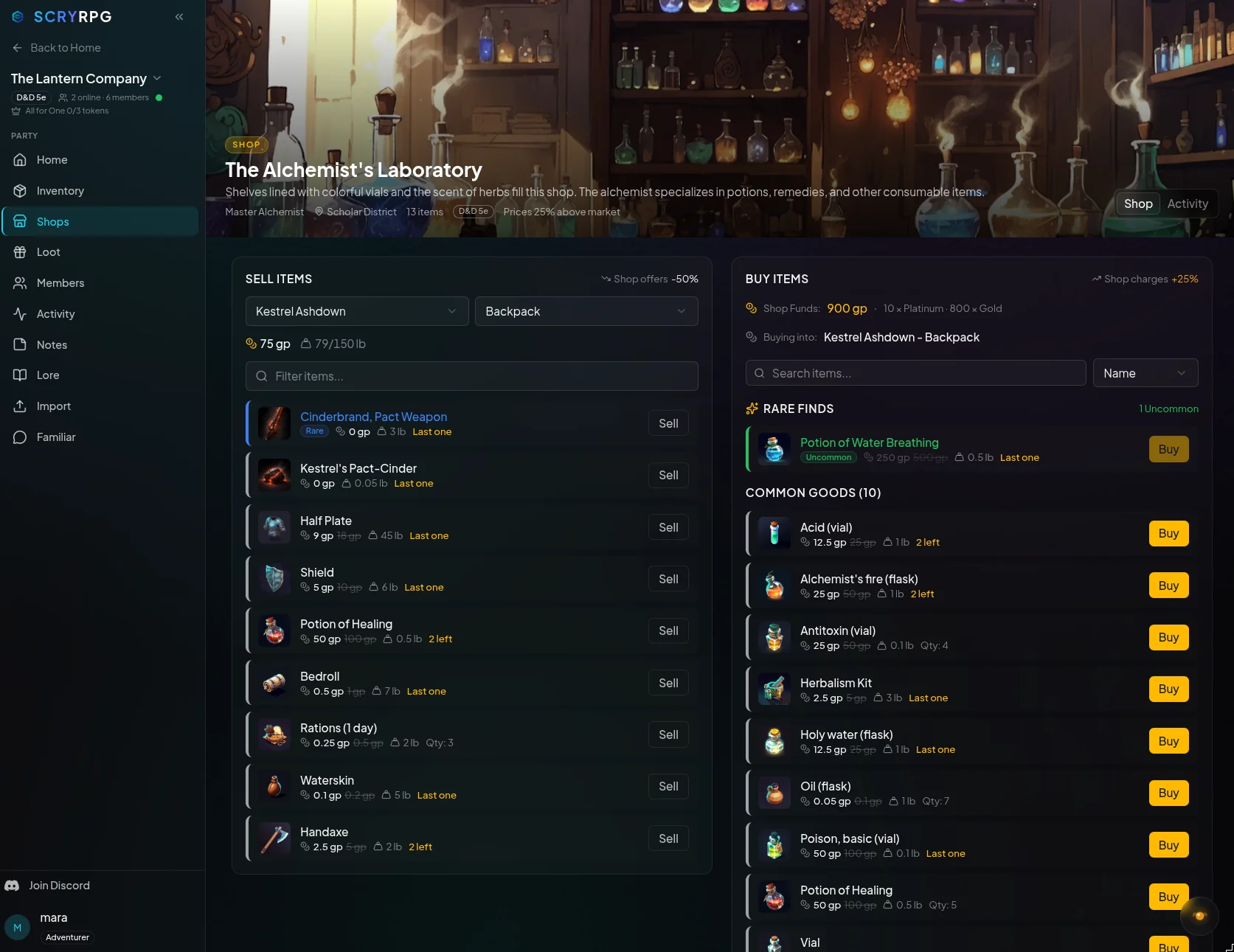
The second is scarcity of quantity. Even items a shop does carry shouldn’t be infinite. Three healing potions in stock. One set of half-plate. Two spell scrolls until the next shipment arrives from the capital. Finite quantities force decisions: do I buy this now, or risk it being gone when I return?
Scarcity also makes discovery possible. If every shop has everything, players never find anything. But when shops are limited and specific, stumbling onto a merchant with unusual stock becomes a moment worth remembering. The players who discover a remote alchemist with a potion no city shop carries have found something real.
That feeling of discovery cannot exist when supply is infinite.
The scarcity principle makes decisions matter. Without it, shopping is just bureaucracy.
Constraints enable creativity by making choices visible.
A shop with “all basic equipment” isn’t helpful. It’s overwhelming. Players faced with two hundred options don’t browse for inspiration; they grab what they already know they need and move on. The interesting items are buried. The creative possibilities remain invisible.
But a shop with a limited selection of basics plus a handful of unusual mundane items sparks different thinking entirely. Manacles. A small mirror. Ball bearings. A collapsible ten-foot pole. Caltrops. A bag of flour.
When these items are visible rather than buried in an equipment dump, players notice them. The artificer sees the mirror and starts scheming about redirecting light. The rogue notices the manacles and files them away for the next time they need to restrain someone. The ranger spots the flour and remembers it reveals invisible creatures.
This is the curation principle: a thoughtfully limited selection creates more engagement than comprehensive access. The shop becomes a creative prompt rather than a homework assignment.
The same principle applies to presentation order. Put the interesting items where players will see them. A curated shop limits options, yes, but more importantly, it directs attention toward the options worth considering.
So far: give players something to want, make supply finite, and curate for visibility. Next: making shops feel real.
Shops are worldbuilding.
A shop should make sense in its location. Geography, culture, economy, and local industry all shape what a merchant stocks and what they specialize in.
A coastal shop might carry a ring of water breathing, nets enchanted to never tangle, and pearls that function as spell components. A shop near an active volcano stocks Flame Tongue weapons, fire-resistant cloaks, and potions of fire immunity at prices that reflect just how badly people need them. A dwarven mining town has the finest metalwork in the region but has never heard of elven silk.
This isn’t just flavor. It makes the world feel coherent, and coherence compounds. Players learn that location matters, that different regions have different resources, that travel might be worth it to find what they need. Each shop reinforces the sense that they’re moving through a world with internal logic rather than a game with convenient spawn points.
The coherence principle also provides an easy design heuristic. When stocking a shop, ask: What’s abundant here? What’s scarce? What would locals actually need? The answers write the inventory.
Prices should follow the same logic. The PHB price list is a starting point, not a mandate. A remote outpost charges more because supply lines are difficult. A city with three competing blacksmiths has lower weapon prices. A merchant who owes the party a favor offers a permanent discount. A shopkeeper the party insulted last session has raised prices just for them.
Custom pricing reinforces that the economy lives and breathes. It also creates levers for rewards and consequences.
Complete a quest for a merchant and earn preferred customer status. Fail a negotiation badly and find the shop more expensive, or find it closed to you entirely.
Changing inventory creates relationships.
Static inventory makes shops one-time stops. Why return to a place that never changes? But dynamic inventory transforms transactions into relationships.
Restock after significant events. The blacksmith has better steel after the players cleared the mine. The alchemist has new potions after the herbalist guild’s shipment arrived. The curiosity shop has something new every time the merchant returns from her buying trips.
Respond to player actions. If the party has been selling monster parts, a craftsman starts making items from them. If they’ve bought every healing potion in town, the alchemist raises prices or simply runs out. If they’ve developed a reputation, shops treat them accordingly.
The dynamism principle turns shops into living systems rather than static menus. Players who know a shop might have something new are players who check back. Players who see their actions reflected in inventory are players who feel their choices matter.
This requires genuine effort to track: notes about what players have purchased and sold, how they’ve treated each merchant, and what events might trigger changes in stock. The payoff is a world that feels genuinely responsive to player choices, and that responsiveness justifies the bookkeeping. But the bookkeeping itself is real, and should be planned for rather than dismissed. (This is exactly the bookkeeping problem ScryRPG inventory was built to eliminate.)
Unknown properties create engagement beyond the transaction.
Not everything in a shop needs a stat block on day one. An unusual item with unclear properties gives players something to investigate, speculate about, and potentially quest for.
Consider how different merchants might present the same essential mystery. The estate liquidator, matter-of-fact: “Belonged to the Vance widow. Her husband wore it every day for forty years, took it off the morning he died. She couldn’t stand to look at it after. I’m not saying there’s a connection, but I’ve priced it like there might be.”
The fence, streetwise and careful: “Fellow who sold me this was sweating through his shirt in winter. Said he needed to be three towns away by morning. Didn’t ask why. Seemed healthier not to. Whatever it does, someone wanted rid of it badly enough to take a loss.”
The antiquarian, scholarly and wondering: “The script here predates the Calixian dynasty by centuries, possibly millennia. I’ve consulted six texts and found nothing resembling it. The blade hasn’t dulled since I acquired it, which was eleven years ago. I clean it every month regardless, out of what I can only call respect.”
Mystery items create engagement that extends far beyond the purchase. Players remember the strange ring in the shop long after they’ve forgotten the rope and rations. They might buy it on speculation, research it in a library, seek out a sage who can identify it, or simply wonder about it for sessions until curiosity wins out.
The mystery principle turns items into threads. A single unidentified object can generate more narrative momentum than a dozen fully-statted magic items.
Scale mystery to your campaign’s appetite for investigation and your own willingness to track the outcomes. A single unidentified item per notable shop creates light intrigue and plants seeds for future sessions. An entire shop of mysteries, whether a dead wizard’s estate sale or a fence who trades in goods of uncertain provenance, transforms the shopping trip into an adventure unto itself. The right density depends on what you can sustain and what your players will actually pursue.
Not every shop needs all six principles at full intensity. A random general store the players visit once doesn’t need mystery items and dynamic inventory. But even throwaway shops benefit from light application.
The minimal version takes thirty seconds of preparation: one aspirational item priced just out of reach, one limitation that reflects the shop’s location, quantities that feel finite rather than infinite, and one sentence in your notes explaining why this particular shop exists in this particular place. That’s enough to elevate a transaction into a small experience, to give players a reason to remember where they’ve been.
Some shops deserve more. These are the places you expect players to return to, the merchants who might become fixtures in your campaign. For these, add a mystery item worth investigating, pricing that reflects the shop’s specific circumstances rather than defaulting to the book, and a note reminding yourself to restock or evolve the inventory after significant events. Now you have a location with a future, not just a present.
And then there are the set pieces: the shops that function almost as adventure sites in their own right. Deep curation that sparks creative problem-solving. Strong coherence with the surrounding world. Dynamic inventory that responds visibly to player actions. Multiple mystery items seeded throughout. A shopkeeper distinctive enough to become a character in the campaign’s story. These shops become places with names players remember, relationships that develop over months of play, anchors in the campaign’s geography.
The principles scale naturally. Apply them lightly for background shops, heavily for important ones, and let player interest guide which shops deserve more investment. Sometimes a throwaway shop catches fire in a way you didn’t expect, and suddenly it’s worth building out. Let that happen.
If you want to see these principles in action, our companion guide provides eight complete shop examples you can use directly or adapt for your campaign.
Retail designers have known for decades that store layout shapes customer behavior in predictable ways. The milk goes in the back so customers walk past everything else. Impulse items cluster near checkout. End caps get the products stores most want to move. Shoppers think they’re making free choices, but the environment is engineering those choices at every turn.
Your shops can do the same thing, not to manipulate players but to create the conditions for engagement. The aspirational item is your end cap, drawing attention and creating goals. Scarcity is your limited-time offer, adding weight to decisions. Curation is your store layout, making certain options visible while others fade to background. The principles aren’t tricks; they’re the architecture of wanting.
Shops are one of the few spaces in TTRPGs where wanting, not survival or obligation, drives player choices. In combat, you fight because you must. On quests, you pursue because the plot demands it or curiosity compels you. But in a shop, players engage because they desire something. That’s a different kind of motivation, and it’s rarer than it seems.
That desire is wasted on vending machines. It’s wasted on infinite inventory at fixed prices. It’s wasted on shops that exist only to restock consumed resources.
But that same desire becomes powerful when there’s something worth wanting. When supply is limited and decisions have weight. When the shop reflects the world and the world responds to the players. When mystery invites investigation and change rewards attention.
A shop with nothing desirable teaches players to stop wanting. A shop with one perfect item, priced just out of reach, teaches them to count every coin.
Design the latter.
The principles are simple. The bookkeeping isn’t.
ScryRPG’s inventory and shop tools handle the bookkeeping so you can focus on motivating your players. Find top-rated shops ready to use, or design your own.